
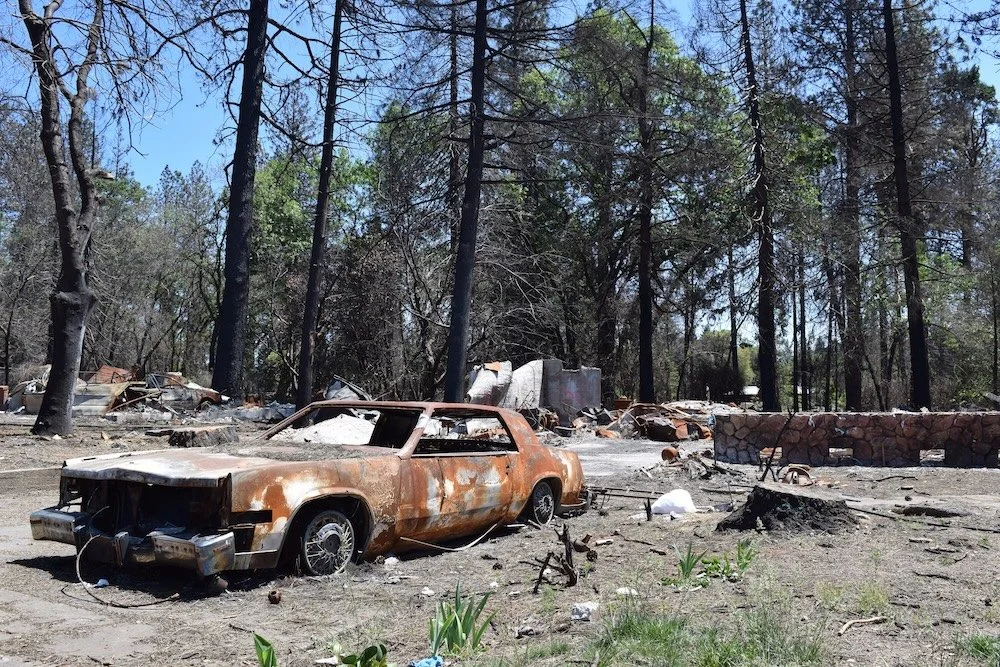
The 2018 Camp Fire that raged for 18 days in Butte County, California, killed 85 people, destroyed nearly 19,000 structures, and caused about $16.5 billion worth of damage. The fire started on November 8 when a power transmission line ignited a fire near the town of Pulga sometime around 6:30 a.m. By the time first responders arrived on scene, the fire had already expanded to ten acres. Air resources were delayed because of the high winds; when they were finally deployed, the fire had already spread 19 miles through the mountains.
The residents of Pulga were told at 7:13 a.m. to evacuate. Concow and Paradise, neighboring communities, were issued evacuation notices by 8 a.m. High winds caused the fire to spread quickly and unpredictably, sending embers flying ahead of the flames and causing spot fires to erupt.
Despite evacuation orders, some people neglected to leave right away, others (more than 40 percent of residents) had never signed up for alert notices so they didn’t learn about the danger immediately, and only 7,000 of the more than 50,000 people living in the area even got the alert signal that was sent out. But as people sounded the alarm with bullhorns and sirens, and as the skies darkened from the black smoke, residents got in their cars to flee. Roads quickly became congested with evacuees, hindering the ability of first responders to fight the fire. First responders changed their focus from suppression of the fire to evacuation of residents, and some firefighting units established Temporary Fire Refuge Areas (TFRAs) in parking lots and other open areas where they provided cover for stranded evacuees as the flames roared past.
Some evacuees abandoned their vehicles and fled on foot. Some evacuees were trapped in their vehicles by flames.
By the 25th of November, the fire was reported to be 100 percent contained. But the aftermath was huge: More than 50,000 people were displaced from their homes. Drinking water was contaminated. Air quality as far away as San Francisco was compromised. The fire, by burning vegetation and charring soil, increased the risk of mudslides and erosion.
Warnings
The fire was not a surprise. Two days before it started, power company PG&E had warned consumers of impending power shutdowns because of a National Weather Service red flag warning calling for high winds and low humidity. But PG&E only shut down power for a limited number of customers.
Thirteen years earlier, in 2005, the California Department of Forestry and Fire Protection warned of a risk for the town of Paradise for experiencing an east wind–led fire like the Oakland firestorm of 1991. And in 2009, a Butte County grand jury reported that the roads in and out of Paradise and nearby communities were inadequate for evacuation because of sharp curves, steep slopes, and inadequate shoulders. The reports were largely ignored.
A fee was assessed on property owners in Wildland-Urban Interface (WUI) areas to help cover the costs of resources needed to protect them. But the fee was repealed due to its lack of popularity.
Lessons
From the Camp Fire, we can learn some key principles to guide preparedness in all communities across North America.
Establish and maintain partnerships. One of the failures during the Camp Fire occurred between partner agencies.
Practice response. All partners require exercises that help them practice coordinating their responses and that turn up gaps in capabilities and plans.
Invest in redundant technologies and keep them up to date. During the fire, multiple communications technologies failed, delaying evacuation and other important responses.
Heed warnings and predictions. People failed to listen to predictive reports and warnings and take action before disaster to mitigate threats.
Prepare Your Community implements these principles throughout our programs and plans. We stress the importance of establishing and maintaining partnerships and formalizing agreements through interlocal agreements (ILAs) and memorandums of understanding (MOUs). We advocate for ongoing training exercises that test plans, equipment, and volunteer training. We recommend investment in redundant technologies that bolster effectiveness even during disaster. And we model the importance of learning from case studies and the disaster experiences of communities across the nation.